

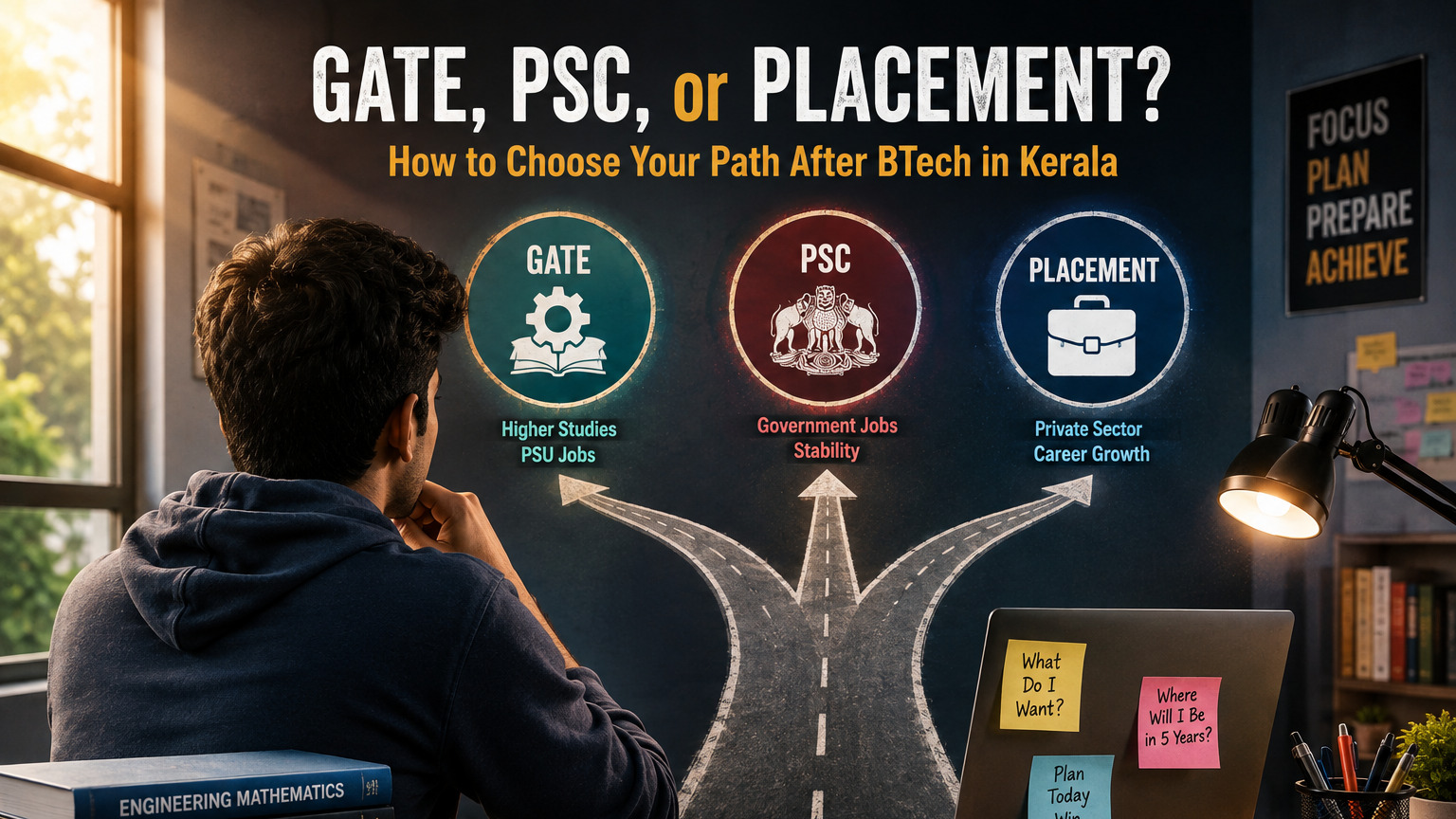
Career Options After BTech in Kerala: GATE vs PSC vs Placement
Third- and final-year BTech students often face the same question from parents, relatives, seniors, and eventually themselves: What are the best career options after BTech in Kerala? Should you prepare for GATE, aim for a Kerala PSC government job, or focus on campus placements and start earning immediately after graduation?
There is no single right answer for every engineering graduate. The best choice depends on your career goals, financial situation, academic strengths, and the kind of professional life you want over the next five years.
Understanding the differences between GATE, Kerala PSC examinations, and campus placements can help you make a practical decision instead of following someone else's career path. Here's how to compare these options and develop a realistic plan for your future.
Understanding Your Career Options After BTech in Kerala
Before choosing a direction, understand what each pathway involves, what preparation it requires, and the opportunities it can offer.
1. GATE: Postgraduate Studies and PSU Opportunities
The Graduate Aptitude Test in Engineering (GATE) is an important option for engineering graduates who want to pursue postgraduate education or explore eligible recruitment opportunities.
A qualifying GATE score can help you apply for MTech and other postgraduate programmes at participating IITs, NITs, and other institutions. Some public sector undertakings also use GATE scores as part of their recruitment processes, depending on the organisation and recruitment cycle.
GATE preparation focuses on engineering fundamentals, subject-specific concepts, numerical problem-solving, and examination strategy. Students generally benefit from following the official syllabus, practising previous-year questions, and taking mock tests regularly.
This pathway may suit you if you enjoy technical subjects, want to specialise in your engineering branch, or are interested in opportunities that require a GATE score.
However, qualifying GATE does not automatically guarantee admission or a PSU job. Institutions and employers have their own eligibility requirements and selection procedures.
2. Kerala PSC: Government Engineering Jobs
Kerala Public Service Commission (Kerala PSC) examinations are another option for engineering graduates interested in eligible government positions.
Depending on the recruitment notification and your qualifications, opportunities may include Assistant Engineer positions, technical posts in state departments, and other government roles.
Preparation requirements vary across examinations. Some technical recruitment tests place considerable emphasis on engineering subjects, while others may include general knowledge, current affairs, reasoning, language skills, or additional subjects.
Before beginning preparation, read the official notification carefully. Confirm the required qualification, age limits, syllabus, selection stages, and application deadlines for the post you want.
PSC preparation often requires patience and consistency because recruitment schedules and vacancies differ between posts. If government service is your goal, starting early can help you build a strong foundation without having to rush through the syllabus after graduation.
This pathway may suit students who are interested in public service, technical government roles, and the responsibilities associated with working in a government department.
3. Campus Placements: Starting Your Career After Graduation
Campus placements offer a route into employment immediately after completing your BTech, depending on the opportunities available at your college and your performance in the selection process.
Depending on your engineering branch and skills, you may apply for IT services companies, software development roles, core engineering positions, product companies, or startups.
Placement preparation can involve aptitude tests, programming, data structures and algorithms, core engineering subjects, technical interviews, communication skills, and project discussions.
If you are interested in software development, building practical projects and strengthening your programming skills can be particularly valuable. For core engineering roles, revising branch-specific concepts and understanding the requirements of the target companies may be more important.
Campus placements may suit students who want to gain professional experience and start earning soon after graduation. However, selection depends on available vacancies, eligibility criteria, competition, and interview performance.
A first job does not prevent you from pursuing further education or preparing for competitive examinations later. Your decision should reflect both your immediate needs and your long-term plans.
GATE vs Kerala PSC vs Campus Placement: Which Should You Choose?
Comparing these pathways side by side can help you identify which option matches your priorities.
| Factor | GATE | Kerala PSC | Campus Placement |
|---|---|---|---|
| Main objective | Postgraduate admissions and eligible recruitment opportunities | Eligible government positions | Private-sector employment |
| Preparation focus | Engineering fundamentals and paper-specific syllabus | Post-specific technical and general syllabus | Aptitude, technical skills, projects and interviews |
| Typical preparation approach | Structured subject study, previous-year questions and mock tests | Syllabus-based preparation and regular practice | Skill development, aptitude practice and interview preparation |
| When you may start earning | Depends on admission, recruitment and your circumstances | Depends on selection and appointment | After securing and joining a job |
| Key consideration | Target score, programme eligibility and recruitment criteria | Vacancy notifications, eligibility and selection stages | Skills, company requirements and available openings |
No pathway is automatically better than the others. GATE, PSC, and placements lead to different opportunities, and each involves its own uncertainties and requirements.
Instead of choosing based only on salary expectations or social pressure, evaluate what matters most to you.
Questions That Can Help You Make the Right Decision
Do you prefer stability or career flexibility?
Government positions may offer structured service conditions and defined career progression, depending on the role and applicable rules. Private-sector employment may provide opportunities to change companies, specialise in different technologies, or move between roles.
Neither option guarantees a particular career outcome. Research the actual positions you are considering rather than making assumptions about an entire sector.
Can you prepare for an examination before earning?
GATE preparation and PSC preparation require time, and selection is not guaranteed. If your family situation requires you to start earning soon after graduation, that is an important consideration.
You may decide to prioritise placements while maintaining a limited study schedule for a competitive examination. Alternatively, if you have sufficient time and a clear academic goal, you may choose to focus more heavily on GATE or PSC.
Be realistic about the time and financial resources you can commit.
What are your strongest skills?
Your existing strengths can help you decide where to begin.
If you understand engineering concepts well and enjoy technical problem-solving, GATE preparation may be a natural fit. If you are interested in government service and comfortable with the syllabus of a particular recruitment examination, PSC may be worth exploring.
If you enjoy programming, practical projects, communication, or solving problems under interview conditions, placement preparation may align with your interests.
These are starting points, not fixed rules. You can develop new skills with consistent effort.
Do you genuinely want the career you're preparing for?
Some students prepare for GATE or PSC because their family considers a government job the safest option. Others pursue placements because their classmates are applying, even though they are interested in postgraduate studies.
Take time to understand what the actual work involves. Read job descriptions, examine postgraduate programmes, speak with professionals, and review the responsibilities associated with the roles you want.
It is easier to sustain preparation when you have a clear reason for pursuing a particular goal.
Do You Have to Choose Only One Path?
Not necessarily. GATE preparation and campus placement preparation can sometimes be managed together, provided you have a realistic schedule and understand the requirements of both.
For example, you may attend placement drives while following a structured GATE study plan. Your college coursework can support both, particularly when you revise engineering fundamentals and practise problem-solving consistently.
PSC preparation can also be combined with another pathway, but the amount of general knowledge, technical revision, and post-specific preparation required will depend on the examination.
The biggest risk is trying to prepare for all three at full intensity during your final semester. Dividing your attention too widely may leave you underprepared for every option.
Choose a primary goal and, if practical, one secondary option. Review your progress regularly and adjust your plan when your priorities or circumstances change.
A Realistic Career Preparation Plan for BTech Students
Your preparation strategy should evolve as you progress through engineering college.
Second Year: Build Your Foundation
Focus on understanding your core engineering subjects rather than studying only to clear semester examinations.
Strengthen your fundamentals, practise problem-solving, and identify the areas you enjoy most. If GATE is a possibility, begin familiarising yourself with the syllabus for your branch.
Students interested in placements can start learning relevant technical skills and building small projects. If PSC interests you, develop a consistent habit of reading and become familiar with the types of examinations relevant to your qualifications.
You do not need to make every career decision immediately. The goal is to build a foundation that keeps several options open.
Third Year: Identify Your Primary Direction
By third year, begin comparing the pathways more seriously.
If you choose GATE, create a subject-wise preparation plan and practise previous-year questions. If placements are your priority, work on technical skills, projects, aptitude, and interview preparation.
If you prefer Kerala PSC, identify relevant recruitment categories, review their official syllabuses, and begin structured preparation.
Use your academic performance, interests, available time, and career goals to determine where to focus your effort.
Final Year: Execute Your Plan
Your final year is when consistent preparation becomes especially important.
Prepare for your primary goal seriously while maintaining a secondary option if your schedule permits. Track important deadlines, eligibility requirements, recruitment notifications, and examination dates.
Avoid adding several new commitments at the last minute. A focused plan that you can follow consistently is generally more useful than an ambitious timetable that becomes unmanageable.
Where Structured Coaching Can Help
Self-study works well for some students, particularly those who can organise their time, understand concepts independently, and evaluate their own progress.
However, students balancing engineering coursework, projects, and competitive examination preparation may benefit from structured guidance.
Coaching can provide a planned syllabus schedule, explanations of difficult concepts, regular assessments, and opportunities to clarify doubts. The value depends on the quality of the programme and how consistently you participate.
At The Lyceum Academy, GATE and Technical PSC coaching is designed to support students preparing for competitive examinations alongside their academic commitments.
The programme focuses on subject-wise coverage, practice tests, and identifying areas that need improvement. Students following KTU engineering programmes can also assess how their university coursework overlaps with the requirements of their chosen competitive examination.
Before choosing any coaching programme, check the syllabus coverage, teaching approach, assessment schedule, and whether the classes fit your college timetable.
How to Choose the Right Career Path After BTech
If you're still uncertain about the best career options after BTech in Kerala, start by writing down your priorities.
Consider these questions:
-
Do you need to start earning soon after graduation?
-
Are you interested in postgraduate studies?
-
Do you genuinely want a government position?
-
Which subjects and professional skills are your strongest?
-
How much time can you realistically dedicate to preparation?
-
What are the eligibility requirements for the opportunities you want?
Your answers will help you narrow your choices and develop a plan based on your circumstances rather than external expectations.
If you're a second- or third-year BTech student in Trivandrum and want guidance on GATE, PSC, or placement preparation, The Lyceum Academy can help you understand the available academic support.
Not sure which path fits you? Book a free demo class with The Lyceum Academy to learn about the coaching approach and discuss your preparation needs. Use the experience to evaluate whether structured guidance is appropriate for your goals.
The most important step is not choosing the path that everyone else recommends. It is understanding your options, setting a realistic goal, and working consistently towards it.