




GATE, PSC, or Placement? How to Choose Your Path After BTech in Kerala?
Third and final year BTech students in Kerala hear this question constantly — from parents, relatives, seniors, and eventually from themselves at 1 AM while scrolling through yet another WhatsApp forward about "the best career path after engineering." GATE? PSC? Just get placed and figure it out later?
There's no single right answer, but there is a right way to think about it — based on what you actually want your next 5 years to look like, not what worked for your cousin or your classmate's brother. Here's how to actually decide.
Start With What Each Path Really Means
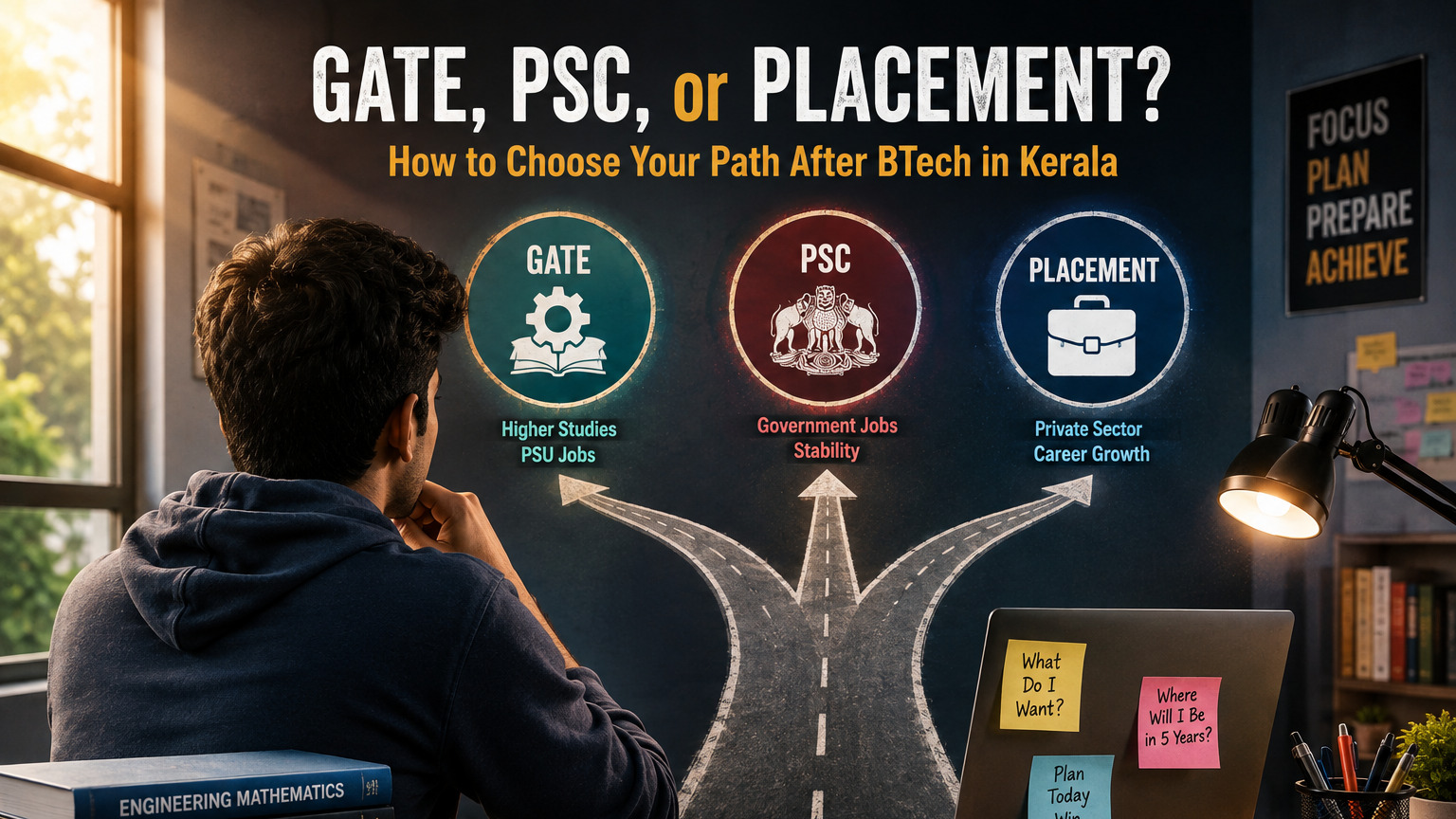
GATE (Graduate Aptitude Test in Engineering) is your route into M.Tech programs at IITs, NITs, and other top institutes, and into PSU jobs (ONGC, BHEL, ISRO, and others) that recruit directly through GATE scores. It rewards strong conceptual fundamentals and consistent, structured preparation over roughly a year.
PSC (Public Service Commission) and other government exams lead to stable government engineering jobs — Kerala PSC Assistant Engineer roles, technical posts in state departments, and similar positions. These reward broad general knowledge alongside core technical subjects, and Kerala has a steady, predictable exam calendar that rewards students who prepare early and consistently.
Campus placement gets you into the private sector immediately after graduation — IT services, core engineering companies, product firms, and startups, depending on your branch and CGPA. It rewards aptitude, communication, and often a portfolio of projects or internships built up during college.
None of these is "better" in an absolute sense. They lead to genuinely different lives — and the right one depends on things only you can weigh.
Questions That Actually Help You Decide
Do you want stability or growth speed? Government roles through PSC and PSU roles through GATE tend to offer long-term stability, defined career ladders, and (for PSU/GATE roles especially) strong starting compensation. Private sector placement often offers faster salary growth and more variety, but with more volatility, especially in the first few years.
Are you willing to prepare for 12+ months before earning? GATE preparation, done properly, usually means a serious 10–14 month runway, often overlapping with your final year. PSC preparation is typically a longer game — many successful candidates prepare for 1–2 years while also working or completing their degree. If your family situation means you need income immediately after graduation, that's a real, valid constraint — factor it in honestly rather than pretending it doesn't matter.
What are you actually good at, not just interested in? Strong fundamentals in core subjects (thermodynamics for mechanical, DBMS and DSA for CS, circuit theory for electrical) make GATE preparation faster and less painful. Strong general awareness, consistent memory-based study habits, and comfort with a broad syllabus suit PSC well. Strong communication, adaptability, and coding fluency (for most branches now) suit placement-focused prep.
Do you actually want a government job, or does it just sound safe? This is worth being honest with yourself about. A lot of GATE and PSC preparation happens because it feels like the "responsible" choice, not because the student has actually pictured themselves in that specific role for the next 20 years. Both paths require serious, sustained effort — that effort is much easier to sustain when the goal is one you actually want, not one you inherited from family expectations.
You Don't Always Have to Pick Just One
This is the part students are rarely told clearly: GATE and campus placement preparation aren't mutually exclusive in your final year. Many students sit for placements while simultaneously preparing for GATE, using the GATE score as a backup or a genuine alternative if placement results don't go the way they hoped, or if a better opportunity opens up later.
PSC preparation is different — it's less about a single final-year sprint and more about a habit you build over a longer runway, often alongside whichever other path you're pursuing. Students who start PSC-relevant reading (general knowledge, current affairs, basic technical revision) early in their degree, even casually, have a real advantage by the time exam notifications actually arrive.
The mistake to avoid is trying to seriously prepare for all three at full intensity in your final semester. That's how students end up doing a mediocre job at everything instead of a strong job at one or two.
A Realistic Way to Structure Your Final Two Years
Second year: Focus on genuinely understanding your core subjects, not just clearing semester exams. This is the foundation that makes both GATE and placement aptitude rounds significantly easier later. If PSC interests you even slightly, start light, consistent general-awareness reading now — it compounds.
Third year: Decide your primary direction based on the questions above. If it's GATE, start structured preparation with subject-wise coverage rather than random topic-hopping. If it's placement, start building projects, revise DSA/core subjects depending on your branch, and take mock aptitude tests. If it's PSC, increase reading consistency and start attempting previous years' question papers.
Final year: Execute your primary plan seriously, while keeping a realistic secondary option open where possible (most commonly, placement alongside GATE). Avoid adding a third serious commitment this late — it's rarely worth the dilution.
Where Structured Coaching Actually Helps
Self-study works for some students, but most benefit significantly from structured coaching for GATE and PSC specifically — not because the material is unavailable elsewhere, but because both exams reward disciplined, syllabus-complete preparation over scattered self-study, and it's genuinely hard to build and stick to that structure alone in your final year while also managing coursework, projects, and (often) placement prep at the same time.
At The Lyceum Academy, our GATE and Technical PSC coaching is built around exactly this problem: subject-wise coverage aligned to the actual exam pattern, regular unit-wise tests so you know where you actually stand rather than guessing, and individual attention rather than a one-size-fits-all lecture pace. We also work with KTU students specifically enough to know where the university syllabus and the exam syllabus overlap — and where they don't.
If you're a second or third-year BTech student in Trivandrum still weighing GATE, PSC, or placement, the most useful next step isn't more scrolling — it's an honest conversation about where you stand and what a realistic plan looks like for your specific branch and timeline.
Not sure which path fits you? Book a free demo class with The Lyceum Academy and talk through your options with faculty who coach both GATE and PSC aspirants every year.